Top 10 Advantages of Flat Pack Containers for Your Business?
In today's fast-paced business environment, efficiency is key. Flat Pack Containers have emerged as a transformative solution for companies seeking streamlined operations. According to a recent report by Smith & Co., businesses that adopt flat pack systems can reduce shipping costs by up to 30%. This significant cost saving highlights the growing popularity of these versatile containers across various industries.
Flat Pack Containers are designed for easy assembly and disassembly. They enable companies to maximize storage space and facilitate smoother transportation. The flexibility they offer allows businesses to adapt quickly to changing market demands. In fact, a survey by the Container Alliance noted that 70% of companies reported increased operational efficiency after switching to flat pack solutions. However, not every organization has adapted swiftly, suggesting a need for better awareness.
As businesses evolve, the importance of innovative solutions cannot be overstated. Flat Pack Containers can indeed provide the edge needed in competitive markets. Yet, while these containers present numerous advantages, companies must carefully consider their supply chain logistics to avoid potential pitfalls. Balancing benefits with realistic expectations is crucial for long-term success.
Advantages of Cost-Effectiveness in Flat Pack Containers
Flat pack containers have revolutionized the way businesses manage logistics. One of their primary advantages is cost-effectiveness. According to a report by Allied Market Research, the global flat pack container market is expected to reach $10 billion by 2027. This growth reflects the increasing reliance on these containers for efficient storage and transport.
Transitioning to flat pack containers can significantly reduce expenses. Traditional shipping containers require higher upfront costs and more storage space. In contrast, flat pack containers can be assembled quickly, minimizing labor costs. Research shows that businesses can save up to 30% on shipping expenses simply by switching to these containers. Additionally, their design allows for greater packing density, further lowering transportation costs.
However, it’s crucial to address potential challenges. While flat pack containers optimize space, not all products fit well within this framework. Fragile or oversized items may still encounter issues during transport. Businesses need to adapt packaging techniques to avoid damage. Ensuring that every product is appropriately packed within these containers can be a continuous learning process. The shift to flat pack containers presents an opportunity, but businesses must remain vigilant and ready to adapt.
Top 10 Advantages of Flat Pack Containers for Your Business
This bar chart illustrates the various advantages of flat pack containers for businesses, highlighting their cost-effectiveness and practical benefits.
Space Optimization and Efficiency in Storage
Flat pack containers are revolutionizing storage solutions for businesses. These containers optimize space effectively. Their collapsible design allows for maximum storage capacity. You can stack or arrange them to fit your specific needs. This modular approach minimizes unused space. Traditional containers often lead to wasted areas. However, flat pack containers adapt to your layout.
Tips for organizing your space: Measure your area before purchasing containers. This way, you can choose the right size. Consider labeling the containers for easy access. It saves time and reduces confusion. A well-organized storage area enhances productivity too.
Flexibility is another advantage. These containers can be easily transported. If your business relocates, the containers move with you. However, they require careful handling, especially when loading and unloading. Not all items are suited for flat pack storage. Evaluating the contents is essential. Are they fragile or bulky? Sometimes, a different solution may be better. Overall, flat pack containers offer remarkable space efficiency.
Flexibility in Transportation and Delivery Options
Flat pack containers provide impressive flexibility in transportation. These containers can easily be shipped in bulk. Their compact design saves space. This allows businesses to optimize logistics and reduce costs. Companies can rapidly adjust their shipping methods. Whether by road, rail, or sea, flat pack containers fit various needs. They adapt to changing schedules and demands.
The convenience of flat pack containers extends to delivery options. Businesses can offer faster service to customers. The ability to assemble on-site means less space is needed at delivery points. Customers enjoy the ease of managing packages. However, it's essential to consider the assembly challenges. Some may struggle with instructions. A little training can significantly enhance the experience.
While flexibility is a key advantage, there can be drawbacks. Miscommunication about logistics can lead to delays. Flat pack containers may not suit all products. Businesses need to assess their needs carefully. Balancing flexibility with efficiency requires thought and planning.
Top 10 Advantages of Flat Pack Containers for Your Business
| Advantage |
Description |
Impact on Business |
| Cost Efficiency |
Flat pack containers reduce shipping costs due to their compact size. |
Lower shipping expenses improve overall profit margins. |
| Space Saving |
Containers can be stacked and stored efficiently when not in use. |
Maximizes storage space in warehouses. |
| Versatility |
Suitable for a variety of products across different industries. |
Flexibility to adapt to different business needs. |
| Easy Assembly |
Quick assembly and disassembly without specialized tools. |
Reduces labor costs and time on site. |
| Durability |
Made from strong materials that withstand transportation stresses. |
Protects goods, minimizing damage during shipping. |
| Eco-Friendliness |
Made from recyclable materials, reducing environmental impact. |
Enhances company’s sustainability profile. |
| Transport Flexibility |
Can be used across different modes of transport (road, rail, sea). |
Streamlined logistics processes. |
| Customizability |
Can be tailored to fit specific business requirements. |
Enhances operational efficiency. |
| Improved Organization |
Easier to categorize and store items within the container. |
Optimizes warehouse management. |
| Scalability |
Easily scalable according to business growth. |
Supports expanding logistics needs. |
Sustainability and Eco-Friendliness of Flat Pack Solutions
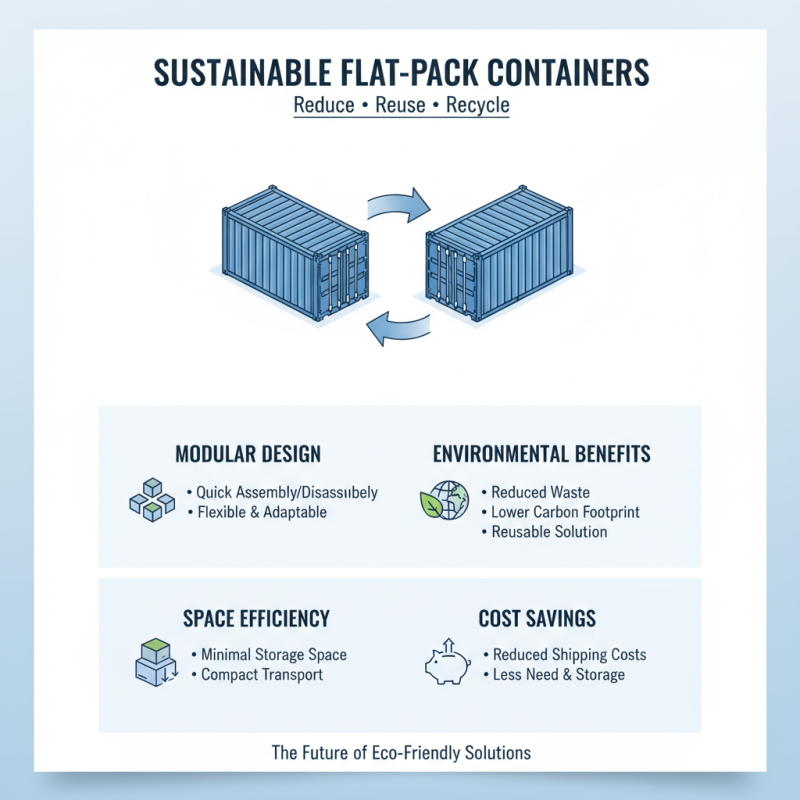
Flat pack containers are becoming increasingly popular due to their sustainability. These solutions are designed for reuse, minimizing waste. They can be assembled and disassembled quickly. This flexibility allows businesses to reduce their environmental footprint. When not in use, they take up minimal space. This efficiency reduces the need for additional storage facilities.
Using flat pack containers promotes eco-friendliness. Their manufacturing often employs recyclable materials, decreasing resource consumption. This approach can lead to lower carbon emissions. Companies that choose these containers reflect a commitment to eco-conscious practices. However, it is essential to ensure that these materials are sourced responsibly. Not all flat pack solutions are created equal regarding sustainability.
While flat pack containers offer several environmental benefits, challenges exist. For instance, not all companies prioritize eco-friendly production. Some might overlook the lifecycle of materials used. Businesses must be vigilant in their choices. They should research and select containers that truly align with sustainable values. Balancing cost and sustainability can be tricky, but it is worth the effort.
Ease of Assembly and Usability for Businesses
Flat pack containers have gained popularity among businesses due to their ease of assembly. These containers come in flat, compact shapes, making them easy to transport. When site workers receive them, they can quickly be set up without specialized tools. Each container includes a manual that guides the assembly process. This simplicity can save time and reduce labor costs.
Tips for assembly: Always lay out all the pieces before starting. This helps prevent losing parts. Also, consider having multiple team members work together. Collaboration can speed up the process and improve accuracy.
The usability of flat pack containers is another major advantage. Once assembled, they are incredibly functional. Whether used for storage, office space, or retail, they adapt to various needs. However, some users find them less spacious than traditional structures. This can be limiting for certain operations. Reflect on your business model to determine the right size for your needs.
Tips for usability: Assess your space requirements before the assembly. Maximize interior space with smart organization. Test different layouts to find what works best for your team. Making adjustments can greatly enhance efficiency.